I was down there with him. I was part of the night. I was the land itself—everything, everywhere—the fireflies and paddies, the midnight rustlings, the cool phosphorescent shimmer of evil—I was atrocity—I was jungle fire, jungle drums—I was the blind stare in the eyes of all those poor, dead, dumbfuck ex-pals of mine—all the pale young corpses, Lee Strunk and Kiowa and Curt Lemon—I was the beast on their lips—I was Nam—the horror, the war (199)
Many people do not like war.
Let’s forget political motivations for a second and briefly talk about realities.
The consequences: a loss of life and youth…of hope. Imagine the psychological game the mind must play on itself—the reasons for action are somewhat abstract, the enemy is blurry and the endgame is hard to realize. Yet all this is irrelevant, because as a soldier you must do as you’re told. You must serve your country. Go to war.
Home meant that everybody already knew what you could do and if you did the slightest little thing different they’d laugh you right down into a hole. You lived in that hole. Festered in it. After a while you either accepted your hole or you got out of it (31)
In this Easy Rawlins mystery we find Easy living with his son Jesus, and other adopted child, Feather. In the heat of an L.A summer, they’re scraping by, but they’re making it. Easy’s ready to settle down with a regular ‘9 to 5’ and abandon the underground private eye practice. He’s ready to get out of his hole because his family needs the consistency and safety. Of course, his desire to do so is blocked by another mystery. This time Easy has to find Black Betty, a woman from his past.
We cannot lift up. Our tongues rot in our mouths from lack of use. Our hearts grow empty and lose strength for our purpose (193)
We’re given a few slices of life, slices of miserable life. Everyone in town is searching for something–an idea, a feeling, or a connection within to verify their existence. What they’re seeking is in other people, in certain routines or motions. But they cannot overcome. Their reasons for being and sustaining are feeble and obscure.
Of all the characters, one in particular, Dr. Copeland, is the most vibrant. Not vibrant in persona, but in his dedication to verify his existence. Dr. Copeland, a black, educated man, in a small Georgian town in the 1930s, is staunch in his convictions because he believes that without them and men like him, the entire black race is doomed to failure; destined to remain at the bottom. Dr. Copeland is also unique because unlike many black people in his community, he does not look to God for empowerment. On the contrary, he looks to worldly solutions.
Some of you young people here this morning may feel the need to be teachers or nurses or leaders of your race. But most of you will be denied. You will have to sell yourselves for a useless purpose in order to keep alive. You will be thrust back and defeated. The young chemist picks cotton. The young writer is unable to learn to read. The teacher is held in useless slavery at some ironing board (193)
John Singer is another character of interest. Strangely enough, Singer is an anomaly in a community of misfits. Not because he cannot hear or speak, but because he seems to be a person everyone else needs. People come to him and talk. Many times Singer offers them simple things that enliven them; food, money, music. Because they can be themselves around him, they value his company and are happier. And when he is gone, they lapse back into desolation.
McCullers captures the gloom of living in a small, southern town, where the heart is a lonely hunter.
It was deeper and more intimate than the fear of evil and capricious gods and of magic, the fear of the forest, and of the forces of nature, malevolent, red in tooth and claw. Okonkwo's fear was greater than these. It was not external but lay deep within himself. It was the fear of himself, lest he should be found to resemble his father (13)
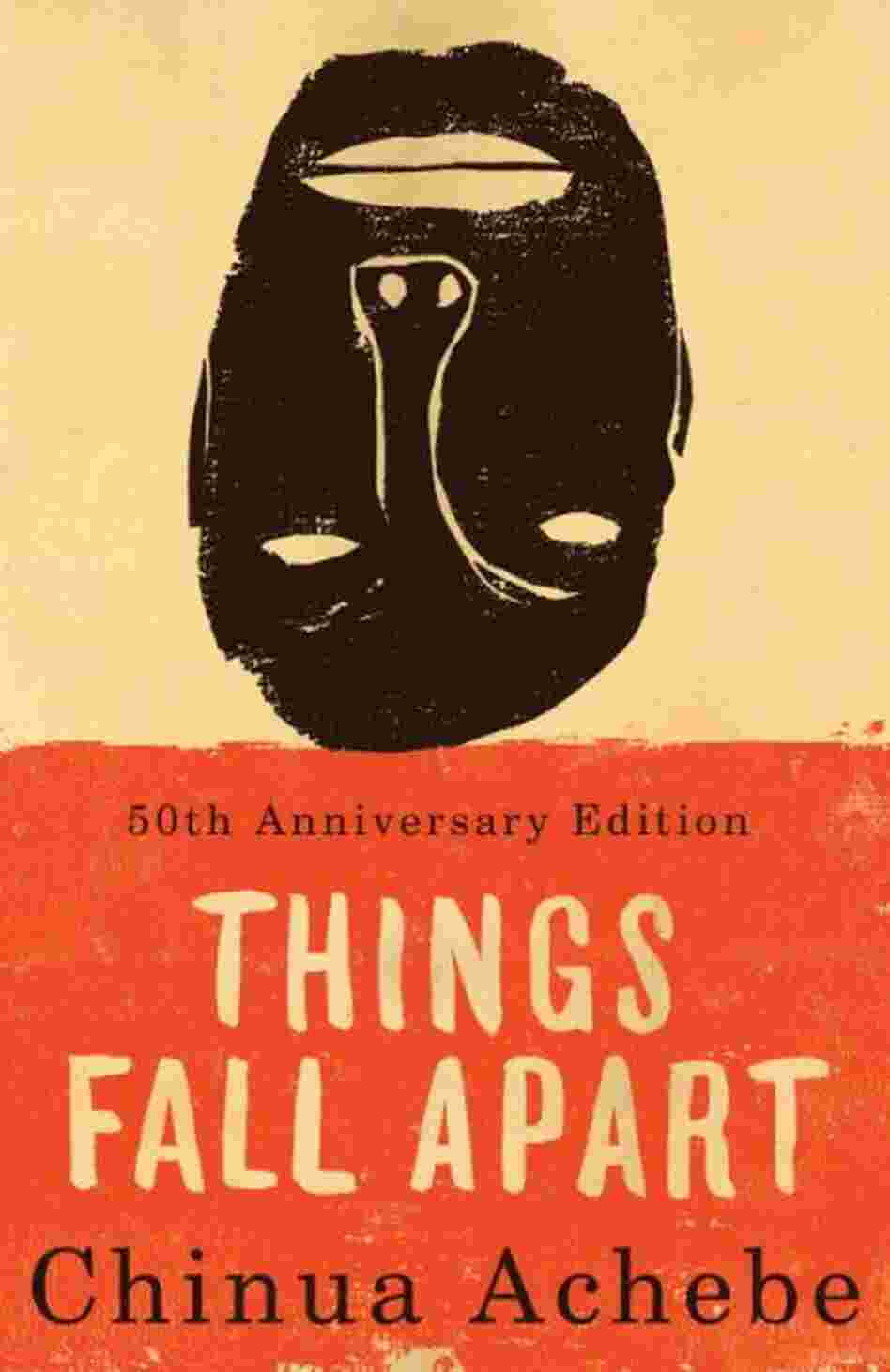
Things Fall Apart is a straightforward story of Okonkwo, an authoritarian and respected figure within his community. Okonkwo is driven solely by his preoccupation with power and rank, which can be traced back to his relationship with his father, a lazy and non prosperous man. Regardless of the circumstance, Okonkwo is able to hold everything together...that is until things fall apart.
It's easy to read this book and admire its simple and folkloric prose. If you've ever wondered why a tortoise shell is uneven and lumpy, this book will tell you why. Some have compared it to something reminiscent of a Greek tragedy...I would agree and add that there's definitely something fable-esque*(?) about it. However, at times the story is so straightforward and uncomplicated that you may find yourself wondering when any actual conflict will ensue. Okonkwo seems to have everything under control. He's a stern man--mean even. And he won't be overcome by any other man.
It's also easy to read this book and conclude that Okonkwo's attitude toward women is negative. He associates some questionable traits and actions with women, and the accusation of a man being feminine is thrown around frequently...but in order to enjoy this book the reader will have to step out of the frame of mind that tells them to be offended (if it offends at all) and realize that's just how it is...I could eurocentralize*(?) this and draw connections between African deities and Greek deities like Tyche...but I won't. Completely unnecessary and overkill for such a simple book.
It was a crime against the earth goddess to kill a clansmen, and a man who committed it must flee from the land. The crime was of two kinds, male and female. Okonkwo had committed the female, because it had been inadvertent (124)
So when do things fall apart? They begin with Okonkwo doing something considered feminine (ironic) and being sent away for seven years. Okonkwo being the thriving creature that he is, fairs well during his absence, but what he returns to is even too much for him. His village has been divided in two, due to the arrival of white men.
It's hard to read the last fifty pages of this book and not feel resentment towards the white men that come and ruin their villages. The thing is, despite how extreme or violent the penal system seemed for Okonkwo and his fellow villagers--it was their system. Their system eradicated the imbalances. It functioned...until the white man arrived, like a virus, spreading their faith and governance. Okonkwo cannot overcome this power struggle, but he refuses to let another man tell him how to lead his life...and so Okonkwo becomes a martyr.
Have you not heard the song they sing when a woman dies? 'For whom is it well. for whom is it well? There is no one for whom it is well' "I have no more to say to you." (135)
* I'm making up all kinds of words for today's post, aren't I? apologies.
I walk by her side, and the darkness lifts from my soul. I walk with her, and I hear the gentle beating of mighty wings...(230)
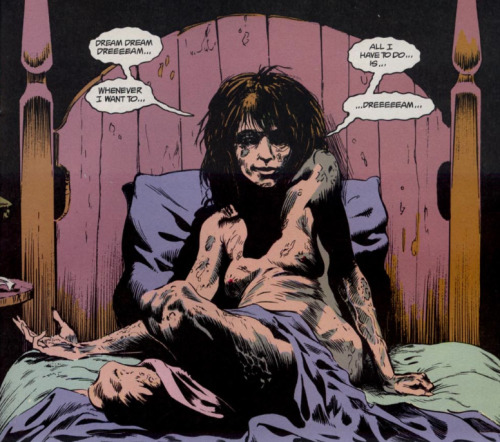
The first of eight, The Sandman Volume One: Preludes and Nocturnes is an intriguing blend of dark, gruesome and playful elements. The illustrations alone are amazing and fitting of the mood of the story. In a nutshell, the reader follows the Sandman on his adventure from capture by occultists to regaining his reign over the realm of dreams and nightmares. The Sandman will encounter a number of zany and horrific characters along his journey.
My favorite part artistically and conceptually (overall really) is 'The Sound of Her Wings'. I love the idea that not only is the Sandman dark yet ambiguous in his intentions, but also that he is morose, brooding (goth, if you will) and searching for something more... And his sister is Death--I love that!
At times the situations presented in the volume seem a little out of focus...that is to say, the concept behind what's happening is good, but it's sort of all over the place. More specifically, I raised an eyebrow at '24 Hours' I really didn't care for Dr. John Dee's side story--seemed extra. However, there is no doubt direction can and will be found in the volumes that follow. I'd be lying if I said this is could be appealing to everyone--because it won't be. All I know is I can't wait to read the other volumes.
You looked at them and wondered why you were so ugly; you looked closely and could not find the source. Then you realized that it came from conviction, their conviction. It was as though some mysterious all-knowing master had given each one a cloak of ugliness to wear, and they had accepted it without question (39)
I can't remember the last time I pitied a character as much as I pitied Pecola Breedlove. While she isn't the main character of this novel she is easily the most important in my opinion. Pecola Breedlove wants blue eyes, like those creepy baby dolls that everyone adores. But she will never have those eyes and she will never be adored as they are--not socially, not romantically, not even adored by her mother or father. In fact, because of her blackness, for she is definitely the wrong kind of black, she's somewhat an outcast within the black community.
Pecola Breedlove. An interesting name. A revealing name. One quick google search* told me the name Pecola means: (1) You sense and feel much that you do not understand, and sometimes you are alarmed at your thoughts and wonder about their origin and (2) You crave understanding and affection but your intensity of desire and your self-consciousness prevent you from finding the happiness you desire. Another search** told me it simply meant "a brazen woman". I find these two definitions somewhat contradicting...the former being more reflective of the trauma Pecola experiences in the book. The latter seems more ironic. It's as ironic as her last name, Breedlove. Pecola is not exactly the product of love and she most likely won't experience any herself.
In fact, The Bluest Eye and the concept of beauty found within it (having blue eyes, lighter skin, non-curly hair) is only one theme that makes this book relevant. It's also about love, or the lack thereof. It's about letting someone or something have so much control over your thoughts and perception that you ultimately accept it as truth. And the truth for Pecola and many blacks in the 1940s is that they weren't lovable-- because of their skin color, they were not deserving of love. And so they did not love each other. Pecola's father hated himself (he had some daddy issues) and so he hated everyone else. He raped his daughter and then hated himself more and his daughter for what he'd done...in this way Morrison marries the concept of love and beauty.
For some reason I was slightly shocked by the sexual content in this book at first...but then I got over it. There are a few graphic scenes, but in the grand scheme they're not inappropriate. Sex and sexuality are outwardly taboo, but it's the thread connecting everyone. Sex created those lighter-skinned and darker- skinned blacks. Sex was veiled as love. Sex numbed the pain and sometimes it fueled the pain. Morrison marries love, beauty, hate, sexuality and history.
In the end, I didn't like this book. But not because of the writing, no, the writing is brilliant, poetic...didactic at times, but some people need things spelled out for them. On a personal note, as someone of color, I've heard these lessons on love and beauty pretty much all my life, so that's probably why it came off as preachy. But it deserves to be read.
*The first search led me here
**The second search led me here
When the firemen sifted through the remains, they would discover Nicole, as her mother suspected. In her embrace would be Sarina and what had happened would be clear. It was murder/suicide. Death by obsession. No further questions asked (287)
::sigh:: When I got this book I was very curious about it because of the cover. Why could that poor, little goldfish be in that blender? For human consumption? Yuck--I had to read it...also on the front cover of my copy it says 'Darkly Funny Gothic Novel'. What I somehow missed is what's written directly under it -- 'Deliciously Catty'. And that's where this book makes it error, or maybe where I made my error in picking this book.While there are some dashes of morbid, gross and dark humor (all things I love) it's overwhelmed by the cattiness and superficial musings of it's characters. Now in defense of this book, I don't have that much experience with Contemporary Southern Gothic fiction...maybe this whole obsession with making Homecoming court at the State University is a big deal and I'm culturally insensitive to it. But if that's not the case, then I'm fine with saying that the best part of this book is the cover.
The story focuses on three characters: Sarina Summers, an oversexed, disgustingly spoiled, attention whore. Nicole Hicks, girl with all the foundations of an axe-murderer and also obsessed with Sarina. And then there's Bitty Jack Carlson; summer camp outcast, and in my opinion the most normal and bearable character. The thing is, I know and enjoy the fact that these characters are supposed to be twisted and exaggerated but it's (1) their roles in the plot and (2) the climax of the plot that's the problem.We follow them from awkward middle school age to end of college age and it seems the priority for each of these characters is revenge and/or redemption through relationships with men. And this irks me...
As I mentioned earlier, there are moments of dark humor: Nicole's shock when she walks in on her brother's alone time, the fact that Bitty Jack's summer boyfriend is star-attraction in a traveling freak show, or the fact that a young Sarina is plagued by a hereditary condition like curved pinkie fingers. The good thing about this novel is it's paced well...very quick. Not too much dwelling on any particular moment of their lives for too long. I guess I should mention that the narrative is supposed to be like a page or chapter in Alice's Adventure in Wonderland. Maybe Bitty Jack is Alice, Sarina is the Red Queen, Nicole is every other cooky character, and the Alabama social scene is Wonderland...not sure because the connection is weak!
I remember at one point thinking this was a Southern Gothic version of Legally Blonde without the law school shenanigans. I still think that's an accurate summary.
Honey, de white man is de ruler of everything as fur as Ah been able tuh find out. Maybe it's some place way off in de ocean where de black man is in power, but we don't know nuthin' but what we see. So de white man throw down de load and tell de nigger man tuh pick it up. He pick it up because he have to, but he don't tote it. He hand it to his women folks. De nigger woman is de mule uh de world so far as Ah can see. Ah been prayin' fuh it tuh be different wid you. Lawd, Lawd, Lawd! (14)
This book is about the 'love life' of Janie Crawford...her three marriages and her development of self. But now that I've finished reading about this brief segment of her life, I still ask--who is Janie Crawford? The answer I'm left with is unclear. The reader never gets a sense of her intellectual or emotional capacity, only physical. She's a beautiful, light-skinned woman, with a long braid of hair which fascinates many men. But other than that I'm not sure. Her marriage and relationship with three different men says more on a societal level of analysis than personal.
In her first marriage Janie is subservient to a husband who sees her as another beast of burden, a vessel, a workhorse. She marries for protection, not love. In her second marriage to Joe Starks, she's subservient but instead of being an instrument, she's a trophy, an object. She marries to escape her first marriage. I have to say I hated Joe Starks. I hate his character and what he stands for. I actually wished ill upon a fictional character and thankfully the plot did not disappoint. The thing is, he's actually the best written character in the book. He is so disgusting in his thirst for envy and status among others in the black community...Her marriage to Tea cake was the most normal of all three marriages. It had the most 'love' and more egalitarian qualities. The whole, 'through sickness and in health, for richer or poorer, till death do us part, blah, blah, blah' applied to them sort of...especially when Tea cake contracts rabies. But even in this most love-filled marriage, she's still subservient, content even, and the lack of character development is disappointing.
"Tony won't never hit her. He says beatin' women is just like steppin' on baby chickens. He claims 'taint no place on uh woman tuh hit," Joe Lindsay said with scornful disapproval, " but Ah'd kill uh baby just born dis mawnin' fuh uh thing lak dat. 'Taint nothin' but low-down spitefulness 'ginst her husband make her do it." (75)
Folkloric charm gives this book a spark of life...and interest for that matter--the 'vernacular'. It's very authentic in that respect. And the gravity in the thoughts and voices of secondary characters, those outsiders looking in--gossip, is revealing of the time.
"You'se different from me. Ah can't stand black niggers. Ah don't blame de white folks from hatin' em cause Ah can't stand 'em mahself. 'Nother thing, Ah hates tuh see folks lak me and you mixed up wid 'em. Us oughta class off." (141)
This book makes many 'must-read' lists...but honestly, I'm having a hard time seeing why. Maybe it's because it's uncovering a truth about intra racism that I already know exists. Maybe because I personally reject the old-fashioned gender roles and power struggles between black men and black women. Maybe because I'm a northern, black woman that inevitably comes from the same southern, black heritage. I don't know.
But I feel as though I'm missing something. Someone tell me...what am I missing?
It was as if what I wanted to kill wasn't in that skin or the thin blue pulse that jumped under my thumb, but somewhere else, deeper, more secret, and a whole lot harder to get at. It would take two motions. One wrist, then the other wrist. Three motions, if you counted changing the razor from hand to hand. Then I would step into the tub and lie down (147)
In The Bell Jar, Plath gives the reader a disturbing and poetic look into the life of a young woman who has slipped into the void. Esther Greenwood, who by many standards should be pleased with her life, isn't. Shortly after interning at a fashion magazine she descends into 'madness'. Trapped under the bell jar, suffocating and withering away, she enters an asylum after attempting suicide.
Is there anything wrong with Esther? Physically--probably not, but the reader won't know for sure. It's the emotional stimuli that are most fascinating, the physical reactions are just that. The emotional hollowness Plath secures for the reader is not drawn from the everyday or a Moody Monday (this novel is semi-autobiographical). It seems that Esther can't help but to have a breakdown. You get the feeling it's in her nature, this destructiveness. And yet there's something very relatable about her. She's selfish and small talk and other everyday interactions leave her feeling stale. Her internship has her surrounded by silly women all day and she doesn't have to work for anything. She feels displaced, so she feels nothing, day in and day out.
Flashbacks to her relationship with her quasi-boyfriend, Buddy Willard are odd. The expectations he has of her and their status are discouraging. The same can be said for all the interactions Esther has with men in this book. Just downright discouraging. I think this aspect of the book is most enduring. That and the descriptions of Esther's melancholic, self-destructive nature:
Then I lifted my right hand with the razor and let it drop of its own weight, like a guillotine, onto the calf of my leg. I felt nothing. Then I felt a small, deep thrill, and a bright seam of red welled up at the lip of the slash. The blood gathered darkly, like fruit, and rolled down my ankle into the cup of my black patent leather shoe (148)
Cobwebs touched my face with the softness of moths. Wrapping my black coat round me like my own sweet shadow, I unscrewed the bottle of pills and started taking them swiftly, between gulps of water, one by one by one...The silence drew off, baring the pebbles and shells and all the tatty wreckage of my life. Then, at the rim of vision, it gathered itself, and in one sweeping tide, rushed me to sleep (169)
The novel is filled with these passages. Lovely, aren't they? I have to say that Esther's anxiety about getting shock treatments gave me anxiety...By the end we see Esther improve somewhat and it seems she will most likely leave the asylum and reenter the world she rejected.
Recommended
The Neverending Story
Pierre and Jean and Selected Short Stories
Disappointments
The Girl with the Dragon Tattoo
The Moonstone
Classics
Pale Fire
The Moonstone
Surprises
Pale Fire
Pierre and Jean and Selected Short Stories
I was about to publish a post about how I wasn't able to finish this challenge, when I realized I already had! Here I am struggling to read The Three Musketeers when I don't need to--ha!
You see my Kindle tells me I'm at 38% and I'm pretty sure I've read at least 300 pages. So the entirety of that book is some absurd number of partially engaging narration. I can't do it. I didn't know the story was that long. Had I known, I would've chosen another book and adjusted my reading schedule accordingly. But like I said, I don't need to. I had already read a book by a French author sometime in July of last year.
At first it was looking like this would be an unsuccessful reading challenge, but it was actually decent: The Neverending Story was wonderful, The Girl with the Dragon Tattoo--overrated, The Moonstone--boring, Pale Fire--leaves me with a question mark and The Three Musketeers--is not at all on the level of The Count of Monte Cristo Pierre and Jean and Selected Short Stories was eclectically morose.
With this complete (We had until January 31st to finish), I can finally focus on my 2013 reads.
What did you know about diaspora? What did you know about Nueba Yol or unheated 'old law' tenements or children whose self-hate short-circuited their minds? What did you know, madame, about immigration? Don't laugh, mi negrita, for your world is about to be changed. Utterly. Yes: a terrible beauty is etc., etc. Take it from me. You laugh because you've been ransacked to the limit of your soul, because your lover betrayed you almost onto death, because your first son was neverborn. You laugh because you have no front teeth and you've sworn never to smile again (160)
I read The Feast of the Goatnot too long ago (click title for review) and I remember thinking how fear, shame and paranoia could spread through the oppressed and the oppressors for individuals in the moment and through generations over time. I have similar feelings about this book; it is a fictionalized account of the generations over time I was referring to. And I mention the Vargas Llosa because of the connection to Trujillo. There are footnotes about Trujillo all over the pages of 'Oscar Wao'. Trujillo's legacy of fear and hate is unleashed upon Oscar and his family, and it has diffused into Dominican culture on the island and in the community in the States.
While I feel Trujillo and things like fuku* are unique to Dominican culture initially, I believe they easily transpose to the American experience, and the struggle with identity many young people face at some point in their lives, or throughout their lives. Oscar is the quintessential example of this: an overweight, ghetto nerd, living and breathing science fiction and fantasy culture and wallowing in self pity and degradation...and his biggest affront--he lacks that famous/infamous Dominican swagger. Poor Oscar is not the object of female affection...well no romantic affections anyways. He's a minority within a minority, a subculture within a subculture. I realize this doesn't sound like much at first, but this preoccupation with love and affection goes deeper than what it appears at the surface. It's present in the love-hate relationship between Oscar's sister, Lola, and their mother, Belicia. Oscar and himself. Lola and her boyfriends. Belicia and her past. Belicia and her family in the DR, Belicia and her mother-figure, La Inca, La Inca and her family, the family and Trujillo, the DR and Trujillo...once again, it's the fuku and the angst of society at work.
Many of the characters in this book have dealt with pain or abuse of some form or another, but Diaz is able to spin threads of humor and realness into the dialogue and narrative, so the read as a whole isn't bogged down with misery. It's filled with playful generalizations, semi-colloquialisms, muted violence, brief dream sequences of a golden mongoose...the 'n-word' is said a lot--on par with the level of usage in the movie Django. It is colorful melancholy and strangely personal (...for me anyways) And while the ending isn't a happy one, it was certainly appropriate. This book is wonderful.
*fuku = curse, doom, superstitious powers, The Curse and Doom of the New World.
I kept my silence and Hobbes took his friendly hand back. I was in a hurry to get to my house. I felt bad about turning down the policeman. I felt miserable that young women would die. But there was nothing I could do. I had my own life to attend to--didn't I? (20)
I flew through this book. It's Mosley's great writing--straightforward, fast-paced and charged with grit. I can't say that this particular story was any better than Devil in a Blue Dress or A Red Death...but I'm at the point where I'm comfortable with the characters, so I don't need to ponder their every action or word spoken. It all just works.
What's new with Easy? Well...he's married with a kid and his adopted son Jesus. One happy family, except not. He's called on once again to help the police find a serial killer of exotic dancers/strippers/women of that variety. But the time Easy spends away from home and enveloped in secrets and the L.A underworld is taking a toll on his family life. This story is as much about personal wrongdoing as it is criminal wrongdoing. What do I mean by personal wrongdoing? ...well in my opinion it seems that Easy only married his wife, so he can say he has a wife and a home. Same goes for his daughter, who is named Edna by the way--shockingly close to his ex-lover/best friend's ex-wife's name, Etta. Now, I'm sure he loves them, but I'm also sure he's more in love with the idea of having a wife and child at home, in the house he bought all those years ago. It's sort of ties back in with his struggle over possession in A Red Death. In the end we see where all his creeping around at questionable hours, in questionable places gets him and the family he always wanted.
White Butterfly didn't leave me with as big an impression as Devil in a Blue Dress did, and that's because I viewed this as a transitional book...Easy once built up, is now stripped down. Again. We'll see what happens in the next Easy Rawlins mystery.
The Earth is beautiful, and bright and kindly, but that is not all. The Earth is also terrible, and dark, and cruel. The rabbit shrieks dying in the green meadows. The mountains clench their great hands full of hidden fire. There are sharks in the sea, and there is cruelty in men's eyes. And where men worship these things and abase themselves before them, there evil breeds...(118)
We meet up with Ged again, on another journey--but not at first. The majority of this short book is dedicated to introducing the character Arha, the High Priestess of The Nameless Ones in the Place of Tombs. She is a living artifact of an old, somewhat forgotten religion and even less relevant to the kingdom of the Godking that rules today...Ged, enters the book much later.
I thought the role of religion in this adventure was interesting. The worship at the Place is very dark in nature. It involves frequent human sacrifice and trips into a labyrinth of tombs and treasure, where no light is permitted. Arha is able to discern that religion means different things for different people. For some it is a pathway to power, for others it's a way of life and for others it's just something to do because there is nothing else to do. Gradually, she uses this realization to form opinions of her circle of acquaintances, and decide who is friend and who is foe. Ged, an outsider, nonbeliever and heathen wizard, whom she discovers in the tombs one day turns out to be friend. He defies everything Arha was told--he lights the darkness. He shows her there is more out there than what is suppressed in the dark labyrinth. He returns her name, Tenar, to her, and frees her from the Place...it was no surprise that some of her fellow temple-folk turn out to be foes.
Plot-wise I didn't enjoy The Tombs of Atuan as much as I did A Wizard of Earthsea, but I think the language in this one is more friendly, and easier to read. I found Ged's origin story in A Wizard of Earthsea to be more compelling than Arha's...she comes across as a very self-righteous, condescending and self-centered character, which can be traced directly to her upbringing. As The Eaten One, she is told the darkness is her domain, and placed on a pedestal. Yet still she is just a girl, young and dumb, with no grasp on how vast and different the world is. Sequestered at the Place, she only knows what the other priestesses have taught her...which is religious worship (until she meets Ged)
At the end of The Tombs of Atuan, Arha still has much to learn about herself. Whereas, by the end of A Wizard of Earthsea, Ged had matured substantially...but Ged also had the freedom to go on a journey of self-discovery. Arha is just now finding this freedom and perhaps in the third book of the Earthsea Cycle, Arha will experience something more.
No, Miss Emily had not a clue as to what ailed me. She could stop herself from eating. I, on the other hand, couldn't help what I did. My urges controlled me. Nevertheless, in Miss Emily's eyes, we were the same. She was the orphan of Ginseng; I was the orphan of Poplar Holler. If she had her way, she'd used our strangeness to unite us (38)
Icy Sparks is a serious yet playful story of a young girl named Icy Sparks, whose adolescence is marred by tics and outbursts she can't control. Icy learns about the value of the truth from a young age. She knows how both her parents died and how their dispositions may have affected her own. She knows she's different and feels her difference should be kept a secret. But the longer she keeps her secrets, the longer the pressure builds and the greater the outburst. These outbursts drastically affect Icy and her relationship with everyone she encounters in the small rural Kentucky community.
Icy is a great character...I can't decide if she's rudely honest or honestly rude. Either way it's charming. I think the author is successful at spotlighting a seriously misunderstood topic in a very humorous and relatable way, with such a character. The narrative is sprinkled with bits like this:
I stared at Wilma's stomach, which was puffing out more than usual, and at her mustache, which had become thicker and hardier in the past few weeks, and gagged at her being pregnant and even harder at the thought of her being the Virgin Mary. "Poor baby Jesus," I whispered. (169)
There are similar interactions between Icy and her best friend and teacher, Emily. Icy spares no feelings about her friend's obesity...They're an interesting duo. I was conflicted because I knew Miss Emily loved Icy and wanted to elevate her, but I didn't know by how much. I wasn't always convinced she wanted Icy to do better; they were outcasts together after all. I'm mostly referring to the exchange they shared over being 'touched'. And by 'touched' I do mean intimately. It was one of the more awkward sections of the book. And yet completely necessary. I think Emily's relationship to Icy worked well because it demonstrates that there are good and bad parts to everyone...and everyone has their own demons.
Overall, this book was good...until the last 50 pages. And I know it had everything to do with Icy's resolution--her epiphany (albeit met with resistance) at the Revival. It shouldn't bother me but it does...the fact that finally succumbing to church theatrics gave her an answer. It was so over the top, so unlike the rest of the book that it threw me off. I think Icy's character was very likeable, interesting and believable, that to toss God in there when she wasn't truly religious was odd. I'm not implying that people don't find God at later phases of their life, because they certainly do, but in this instance it was...forced? I think I'm going to go with word forced.
When I reread the section I came to the conclusion that it wasn't actually the institution that gave Icy the relief; she could care less if she attended a Catholic church, Baptist, Methodist, etc. It was that feeling of community and acceptance. That feeling of belonging. Icy was able to jump headfirst into something with no fear or threat of rejection. In this way, singing with several church choirs, she could finally be part of the community that had estranged her since childhood. At least that's what I told myself to help from being completely disappointed with the ending.
Surely, you don't disbelieve the prophecies, because you had a hand in bringing them about yourself? You don't really suppose, do you that all your adventures and escapes were managed by pure luck, just for your sole benefit? You are a very fine person, Mr. Baggins, and I am very fond of you; but you are only quite a little fellow in a wide world after all! (303)
I read The Hobbit as a read-along hosted at Unputdownables. Although the read-along is scheduled for another two weeks, I went ahead and finished the last 75 pages, so I can see the movie. Honestly, I don't want to over-analyze or even really analyze this book--why? because it's been done before, and I didn't feel too strongly about anything to offer up any commentary. But that doesn't mean I didn't like the story. I quite enjoyed it. Tolkien created a solid story of adventure, good over evil and self-discovery. (Of course he did, he's J.R.R Tolkien)
Many people have already read the book, or will see it in theaters, so I guess it might make sense to bring up what was discussed in the read-along...because there were a few things that others brought up that I couldn't understand...for example, I was met with slight resistance when I suggested that Gandalf was an all-knowing figure and obviously powerful. Others said no (which is fine, I don't have to be right) but how they could deny his 'all-knowingness' was odd to me. They say he's 'wise'. I say yes, most definitely, but he knows way more about the direction of the journey than he lets on. They say he can influence the sequence of events, but can't predict the outcome...and in my head, if someone can influence the chain of events so that it almost always leads to a favorable ending, that's pretty damn powerful to me. But anyways, that was one thing.
Maybe, I won't go into the other odd things from the discussions (it's related to ponies and handkerchiefs)...after all I did enjoy the book Here are couple of passages that I really liked:
They walked in single file. The entrance to the path as like a sort of arch leading into a gloomy tunnel made by two great trees that leant together, too old and strangled with ivy and hung with lichen to bear more than a few blackened leaves. The path itself was narrow and wound in and out among the trunks. Soon the light at the gate was like a little bright hole far behind, and the quiet was so deep that their feet seemed to thump along while all the trees leaned over them and listened (139)
Paths had vanished, and many a rider and wanderer too, if they tried to find the lost ways across. The elf-road through the wood which the dwarves had followed on the advice of Beorn now came to a doubtful and little used end at the eastern edge of the forest; only the river offered any longer a safe way from the skirts of Mirkwood in the North to the mountain-shadowed plains beyond, and the river was guarded by the Wood-elves' king. So you see Bilbo had come in the end by the only road that was any good (189)
So, yeah. That's all I got...now to see the movie.
It is a sad thing to think of, but there is no doubt that Genius lasts longer then Beauty. That accounts for the fact that we all take such pains to over-educate ourselves. In the wild struggle for existence, we want to have something that endures, and so we fill our minds with rubbish and facts, in the silly hope of keeping our place (14)
Basil Hallward paints a remarkable portrait of his friend and muse, Dorian Gray. It's his best work, something to be admired. Yet the piece of art becomes an object of hate and fear. Basil has given eternal life and beauty to the Dorian in the portrait, whereas, the actual Dorian will eventually be marked with imperfection, age and ugliness. To Dorian it's unfair and unbecoming, and somehow he inadvertently sells his soul for eternal youth.
Dorian undergoes an intellectual and moral transformation. The change of his psyche is contrasted with the stagnation of his physical being. He doesn't age. He becomes a fickle person, seeking sin, pleasure or any experience that can satisfy his search for what he considers beauty or novelty of the moment. He commits a heinous crime, develops shady habits and ruins his reputation. He goes from loved by all to detested by most. He has the face of youth, innocence and good, but not the soul to match.
I have such mixed feelings about this book. The beginning was rough for me because I kept running across passages like this:
He was bareheaded, and the leaves had tossed his rebellious curls and tangled all their gilded threads. There was a look of fear in his eyes, such as people have when they are suddenly awakened. His finely chiseled nostril quivered, and some hidden nerve shook the scarlet of his lips and left them trembling (23)
...and this:
As he thought of it, a sharp pang of pain struck through him like a knife, and made each delicate fiber of his nature quiver. His eyes deepened into amethyst, and across them came a mist of tears. He felt as if a hand of ice had been laid upon his heart (27)
Aren't they too--I don't know--mushy?
I suppose they're meant to be romantic and artistic, but I find the descriptions, in particular the use of the word quiver very irksome.
Maybe it's just me.
Anyways, once I got over that, I was annoyed with Harry/Lord Henry. His musings, while very quotable, are silly. However, he's such an important character in the book. It's clear that his haughty attitude and naturalist view of society influence Dorian Gray substantially. In fact, Dorian becomes Harry's social experiment. Harry poisons, pokes and prods hims; drops crumbs, which eventually lead Dorian to corruption.
I didn't start liking the book until Dorian's final meeting with Basil...and his trips to the underworld of opium dens. And even then...not so much. All this talk of innocence and beauty and souls made me think of this song:
Listening to it repeatedly, while reading the last few chapters helped me get through it.
The best time to cry is at night, when the lights are out and someone is being beaten up and screaming for help (1)
Monster is about the fate of a young man named Steve Harmon. There is a good chance Harmon will get 25 years to life in prison, if found guilty of felony murder. In Monster, the emotional turmoil Harmon experiences in prison and during his trial is documented into a screenplay. He does this to help him process the extreme turn his life has taken. In between scenes, Harmon has diary entries that speak more to the cruel circumstance of prison life.
Miss O'Brien says that Petrocelli is using Bolden's testimony as part of a trail that will lead to me and James King. I think she is wrong. I think they are bringing out all of these people and letting them look terrible on the stand and sound terrible and then reminding the jury that they don't look any different from me and King (59)
The author focuses on what it means to be guilty, or rather, what it means to not be innocent. He includes little details about Harmon's life, upbringing and neighborhood to suggest how men like Harmon are predisposed to guilt. This same guilt consumes almost every person in prison (innocent or not). Guilt manifests and infiltrates everyone. It's not a jacket you take off whenever you please; it's the pain in your gut, the bag over your head, tattooed on your forehead, multiplying in the melanin of your skin.
I hear myself thinking like all the other prisoners here, trying to convince myself that everything will be alright, that the jury can't find me guilty because of this reason. We lie to ourselves here. Maybe we are here because we lie to ourselves (202)
At first I was unsure of how the structure of a screenplay would affect the reading experience. Would it distract me? Can I visualize these scenes correctly? Would I understand what Harmon is trying to emphasize? Yes, some phrasing is a little awkward, but the dialogue is clear. In the end I decided what mattered more was the idea of the screenplay; the fact that the reality of Harmon's situation--the gravity of it--the bleakness of his future is so unbelievable that only a movie could capture the sensation.
Another thing I noted when reading was the overall indifference I felt to all the characters...I'm not sure if this is a good or bad thing. I didn't hate the prosecutor, I didn't empathize with Harmon, all the witness accounts and cross examinations seemed solid, the prisoner advice was casually reflective. I didn't spend any brainpower on forming my own judgement on whether Harmon was not guilty--I was just indifferent. I'm sure this due to the form of the narrative, as the reader is just there to observe. I feel weird suggesting that there's no reader engagement because I did find the novel interesting enough...
I wish Jerry were here. Not in jail, but somehow with me. What would I say to him? Think about all the tomorrows of your life. Yes, that's what I would say. Thank about all the tomorrows of your life (205)
Animated chaos, the profound need in what was once your people, Urania, to stupefy themselves into not thinking and, perhaps, not even feeling (6)
The Feast of the Goat takes place during the end of the Trujillo dictatorship in the Dominican Republic. It contains the narrative of the infamous Rafael Leonidas Trujillo Molinas--el Jefe--as well as the narratives of the daughter of one of his top officials and the many subversives and anti trujillistas, that take part in his assassination.
The book begins with the narrative of Urania Cabral, daughter of one of the most distinguished Trujillo loyalists. She visits the DR for the first time in 35 years after having lived in the United States, to see her father who has degenerated into a vegetable. Despite his condition, Urania is bitter and borderline hateful towards him. Little by little her narrative sheds light on how Trujillo caused this woman to stupefy herself, to hate her father and become estranged from her people. Her story and the flashbacks within it, frame the other narratives.
And then it occurred to him: "A cure equal to the disease." The face of a beautiful woman, exploding with pleasure in his arms, thanking him for the joy he had given her. Wouldn't that erase the frightened little face of that idiot? Yes: he'd go tonight to San Cristobal, to Mahogany House and wipe away the affront in the same bed with the same weapons (128)
The one ever-present element in this book is the intertwine of sex, politics and machismo, especially in Urania's and Trujillo's narratives. It seems when Trujillo isn't ordering people around, he's thinking about taking a trip to the Mahogany House (the local upscale brothel) What's interesting about this is Vargas Llosa parallels failings of the Trujillo regime with the failings of Trujillo's body; old age, impotence and incontinence.
Whereas Urania is repelled by anything suggestive, or of a sexual nature, due to certain events in her adolescence which can be directly linked to Trujillo. In fact, I would go as far to say that Trujillo and Urania are complementary characters in almost every level of analysis. Trujillo holds a very low opinion of intellectuals, artists and writers, people whose work influence the evolution of thought, challenge his sovereignty. Urania falls into that category, not only professionally, but personally. And not just on an intellectual level, a physical one.
It must be nice. Your cup of coffee or glass of rum must taste better, the smoke of your cigar, a swim in the ocean on a hot day, the movie you see on Saturday, the merengue on the radio, everything must leave a more pleasurable sensation in your body and spirit when you had what Trujillo had taken away from Dominicans thirty-one years ago: free will (144)
I could go on and on about gender, sex and politics in this book. It's a really good book to analyze for that type of reading. But generally speaking, I think this book is great because it shows how fear, shame and paranoia can spread like a disease in all parties. They spread through the oppressed and the oppressors--and not just in those individuals in the moment, but through generations over time.
Down you go, but all the while you feel suspended and buoyed as you somersault in slow motion like a somnolent tumbler pigeon, and sprawl supine on the elderdown of the air, or lazily turn to embrace your pillow, enjoying every last instant of soft, deep, death-padded life, with the earth's green seesaw now above, now below, and the voluptuous crucifixion, as you stretch yourself in the growing rush, in the nearing swish, and then your loved body's obliteration in the Lap of the Lord (221)
Where to start with this book....there are two narratives; one of John Shade, the poet, who led a relatively uninteresting life, with the exception of a recurring preoccupation with death. His narrative is confined to four cantos of poetry. The other is Charles Kinbote, neighbor of Shade and self-proclaimed editor of Shade's work. His narrative starts with the foreword, continues with the commentary and ends with the index. The reader will quickly learn that Kinbote is not exactly what he seems. I find him to be sort of a Shade groupie, a megalomaniac and his sense of entitlement and self-importance is quite annoying. But I think this is intentional...I expected the commentary to be an explication, a means to delve deeper into Shade's intent, but instead we are given huge chunks of the story of Kinbote. As I read about the escape of a self-exiled King Charles of the imaginary Zembla, I'm only thinking about how peculiar it is for the commentary to not be exclusively about Shade or his work. Especially, since I think Shade's upbringing and encounters with death have more gravity than Kinbote's predicament. Why does this happen?
I can't tell you how/ I knew--but I did know that I had crossed/ The border. Everything I loved was lost/ But no aorta could report regret./ And blood-black nothingness began to spin/ A system of cells interlinked/ Within one stem. And dreadfully distinct/ Against the dark, a tall white fountain played (59)
I think this is one of those books that could be read more than once and each time something different pulled from it. I feel the need to say that I didn't read Pale Fire in order, I skipped around. I read the poem first, and then the foreword and then the commentary/index. I'm not exactly sure why I did this, but I felt like I needed to read Shade's work without Kinbote's influence...There is something to be said when a poet has already reduced his life to 999 lines of poetry and the editor takes it upon himself to insert entire complex/and or absurd memories into a work that isn't about him. He reached beyond the space of the foreword--I think there's criticism about literary criticism here...at least that's what I took from it because Kinbote is pretty much ridiculous.
Very interesting meta fiction (?) Definitely something I would consider rereading and probably need to reread.
I enjoyed this challenge mainly because I read across genres and found some great reads...I also discovered that finding an interesting book with 'brown' in the title is quite difficult. Anyways, here's the breakdown:
Recommended
Coal Black Horse
The Autobiography of an Ex-colored Man
Devil in a Blue Dress
Disappointments
The Man in the Brown Suit
The Devil in the White City
The White Woman on the Green Bicycle
'Classics'
The Yellow Wallpaper
A Clockwork Orange