Showing posts with label European literature. Show all posts

1.26.2013

European Reading Challenge 2012 - Complete


My Reading Selection

Germany - The Neverending Story
Sweden - The Girl with the Dragon Tattoo
England - The Moonstone
Russia - Pale Fire
France - Pierre and Jean and Selected Short Stories

Recommended
The Neverending Story
Pierre and Jean and Selected Short Stories

Disappointments
The Girl with the Dragon Tattoo
The Moonstone

Classics
Pale Fire
The Moonstone

Surprises
Pale Fire
Pierre and Jean and Selected Short Stories


I was about to publish a post about how I wasn't able to finish this challenge, when I realized I already had! Here I am struggling to read The Three Musketeers when I don't need to--ha!

You see my Kindle tells me I'm at 38% and I'm pretty sure I've read at least 300 pages. So the entirety of that book is some absurd number of partially engaging narration. I can't do it. I didn't know the story was that long. Had I known, I would've chosen another book and adjusted my reading schedule accordingly. But like I said, I don't need to. I had already read a book by a French author sometime in July of last year.

At first it was looking like this would be an unsuccessful reading challenge, but it was actually decent: The Neverending Story was wonderful, The Girl with the Dragon Tattoo--overrated, The Moonstone--boring, Pale Fire--leaves me with a question mark and The Three Musketeers--is not at all on the level of The Count of Monte Cristo Pierre and Jean and Selected Short Stories was eclectically morose.

With this complete (We had until January 31st to finish), I can finally focus on my 2013 reads.

12.03.2012

Review - The Picture of Dorian Gray


The Picture of Dorian Gray 
by Oscar Wilde
200+ pages

Description via Goodreads
It is a sad thing to think of, but there is no doubt that Genius lasts longer then Beauty. That accounts for the fact that we all take such pains to over-educate ourselves. In the wild struggle for existence, we want to have something that endures, and so we fill our minds with rubbish and facts, in the silly hope of keeping our place (14)
Basil Hallward paints a remarkable portrait of his friend and muse, Dorian Gray. It's his best work, something to be admired. Yet the piece of art becomes an object of hate and fear. Basil has given eternal life and beauty to the Dorian in the portrait, whereas, the actual Dorian will eventually be marked with imperfection, age and ugliness. To Dorian it's unfair and unbecoming, and somehow he inadvertently sells his soul for eternal youth.

Dorian undergoes an intellectual and moral transformation. The change of his psyche is contrasted with the stagnation of his physical being. He doesn't age. He becomes a fickle person, seeking sin, pleasure or any experience that can satisfy his search for what he considers beauty or novelty of the moment. He commits a heinous crime, develops shady habits and ruins his reputation. He goes from loved by all to detested by most. He has the face of youth, innocence and good, but not the soul to match.

I have such mixed feelings about this book. The beginning was rough for me because I kept running across passages like this: 
He was bareheaded, and the leaves had tossed his rebellious curls and tangled all their gilded threads. There was a look of fear in his eyes, such as people have when they are suddenly awakened. His finely chiseled nostril quivered, and some hidden nerve shook the scarlet of his lips and left them trembling (23)
 ...and this:
As he thought of it, a sharp pang of pain struck through him like a knife, and made each delicate fiber of his nature quiver. His eyes deepened into amethyst, and across them came a mist of tears. He felt as if a hand of ice had been laid upon his heart (27)
Aren't they too--I don't know--mushy?

I suppose they're meant to be romantic and artistic, but I find the descriptions, in particular the use of the word quiver very irksome.

Maybe it's just me.

Anyways, once I got over that, I was annoyed with Harry/Lord Henry. His musings, while very quotable, are silly. However, he's such an important character in the book. It's clear that his haughty attitude and naturalist view of society influence Dorian Gray substantially. In fact, Dorian becomes Harry's social experiment. Harry poisons, pokes and prods hims; drops crumbs, which eventually lead Dorian to corruption. 

I didn't start liking the book until Dorian's final meeting with Basil...and his trips to the underworld of opium dens. And even then...not so much. All this talk of innocence and beauty and souls made me think of this song:


Listening to it repeatedly, while reading the last few chapters helped me get through it. 

The Picture of Dorian Gray

Three stars. 

Smooth Criminals, Reading Challenge for 2012

10.19.2012

Review - Pale Fire


Pale Fire
by Vladimir Nabokov
300+ pages

Description via Goodreads
Down you go, but all the while you feel suspended and buoyed as you somersault in slow motion like a somnolent tumbler pigeon, and sprawl supine on the elderdown of the air, or lazily turn to embrace your pillow, enjoying every last instant of soft, deep, death-padded life, with the earth's green seesaw now above, now below, and the voluptuous crucifixion, as you stretch yourself in the growing rush, in the nearing swish, and then your loved body's obliteration in the Lap of the Lord (221)

Where to start with this book....there are two narratives; one of John Shade, the poet, who led a relatively uninteresting life, with the exception of a recurring preoccupation with death. His narrative is confined to four cantos of poetry. The other is Charles Kinbote, neighbor of Shade and self-proclaimed editor of Shade's work. His narrative starts with the foreword, continues with the commentary and ends with the index. The reader will quickly learn that Kinbote is not exactly what he seems. I find him to be sort of a Shade groupie, a megalomaniac and his sense of entitlement and self-importance is quite annoying. But I think this is intentional...I expected the commentary to be an explication, a means to delve deeper into Shade's intent, but instead we are given huge chunks of the story of Kinbote. As I read about the escape of a self-exiled King Charles of the imaginary Zembla, I'm only thinking about how peculiar it is for the commentary to not be exclusively about Shade or his work. Especially, since I think Shade's upbringing and encounters with death have more gravity than Kinbote's predicament. Why does this happen? 
I can't tell you how/ I knew--but I did know that I had crossed/ The border. Everything I loved was lost/ But no aorta could report regret./ And blood-black nothingness began to spin/ A system of cells interlinked/ Within one stem. And dreadfully distinct/ Against the dark, a tall white fountain played (59)
I think this is one of those books that could be read more than once and each time something different  pulled from it. I feel the need to say that I didn't read Pale Fire in order, I skipped around. I read the poem first, and then the foreword and then the commentary/index. I'm not exactly sure why I did this, but I felt like I needed to read Shade's work without Kinbote's influence...There is something to be said when a poet has already reduced his life to 999 lines of poetry and the editor takes it upon himself to insert entire complex/and or absurd memories into a work that isn't about him. He reached beyond the space of the foreword--I think there's criticism about literary criticism here...at least that's what I took from it because Kinbote is pretty much ridiculous. 

Very interesting meta fiction (?) Definitely something I would consider rereading and probably need to reread.

Pale Fire

Three stars.


7.02.2012

Review: Pierre and Jean and Selected Short Stories


Pierre and Jean and Selected Short Stories
Author: Guy de Maupassant
Pages: 350+

Description via Goodreads

My thoughts:

Let's start with some fun facts about the author:

1) Gustave Flaubert was his mentor.
2) He has written over 300 stories
3) He was the child of an unhappy marriage.
4) He was a naturalist.
5) He contracted syphilis and died in a sanitarium at the age of 43.
6) He is considered to be a father of the modern short story.
 
These are not necessarily the most important or defining facts about him, but they are certainly very interesting.The nineteen short stories included in this collection are all written and translated very well. Maupassant precisely writes stories of love, society, rivalry, adultery; all filled with an array of darker human emotions: lust, jealousy, fear, guilt, hate, shame. 

His novel Pierre and Jean is a quintessential example of simple and realistic writing. The short novel describes a typical sibling rivalry enhanced by the discovery of a mother's infidelity and consequently, the illegitimate standing of a son and the wedge driven between brothers. While this is the leading story, it was not one of my favorites. I preferred The Roque Girl for its sadness, Marroca for its lightness, and Mad? for its disturbing turn.
My friend, there are two tortures on this earth that I hope you nver experience: lack of water and lack of women. Which is more horrible? I don't know. In the desert, a man would do anything, however infamous, for a glass of cold, clear water. What wouldn't he do in certain coastal towns for a fresh, healthy girl? There's no shortage of girls in Africa, far from it: they're in plentiful supply. But to continue my comparison, they're as dangerous and tainted as the foul water of a well in the Sahara.
The one story I was really looking forward to, although I couldn't pinpoint why, was Le Horla. And it wasn't until after I read it that I remembered (A few years ago a discussion over Don Quixote's and Cervantes' sanity, brought up Maupassant's name) It kind of makes sense now. Syphilis can make a person go crazy. This story of paranoia and clepto-vampires that will steal your breath, milk and peace of mind is odd, to say the least. But I don't know that he was crazy when he wrote it...I felt the same way about Cervantes. I think Le Horla is an accurate portrayal of teetering over the edge.

I can easily see how his writing influenced generations of American and European writers. I don't want to say he perfected a formula for his stories, but he was very successful in writing solid stories by exposing what he observed in the everyday, mixing in a little drama and including a 'surprise' ending. I will certainly read more of his work. I'm thinking Boule de Suif and The Necklace.

Pierre and Jean and Selected Stories

Four stars.


5.23.2012

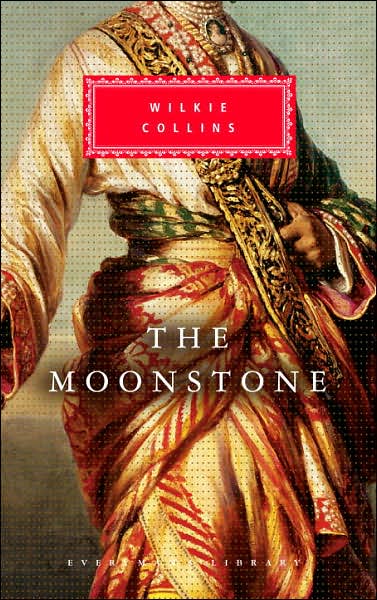
Review - The Moonstone

The Moonstone
Author: Wilkie Collins
Pages: 350+

Description:

Rachel Verinder, a young Englishwoman, inherits a large Indian diamond on her eighteenth birthday. It is a legacy from her uncle, a corrupt English army officer who served in India. The diamond is of great religious significance as well as being extremely valuable, and three Hindu priests have dedicated their lives to recovering it. The story incorporates elements of the legendary origins of the Hope Diamond (or perhaps the Orloff Diamond). Rachel's eighteenth birthday is celebrated with a large party, whose guests include her cousin Franklin Blake. She wears the Moonstone on her dress that evening for all to see, including some Indian jugglers who have called at the house. Later that night, the diamond is stolen from Rachel's bedroom, and a period of turmoil, unhappiness, misunderstandings and ill-luck ensues. Told by a series of narratives from some of the main characters, the complex plot traces the subsequent efforts to explain the theft, identify the thief, trace the stone and recover it.

My thoughts:

First order of business, I'd like to give myself a pat on the back for finishing this book. I truly dreaded almost every moment of it.

The book is filled with social satire and witty commentary. Some are funny, many are not. Here, I'll let you be the judge:
A cloak (on a woman's back) is an emblem of charity -- it covers a multitude of sins (84)
Follow me carefully, and I will prove it in two words. You choose a cigar, you try it, and it disappoints you. What do you do upon that? You throw it away and try another. Now observe the application! You choosea woman, you try her, and she breaks your heart. Fool! take a lesson from your cigar-case. Throw her away, and try another! (124)
Poor thing! the bare idea of a man marrying for his own selfish and mercenary ends had never entered her head (194) 
Have you had enough? because there's a ton more I can share, thanks to the narratives of Betterredge.
 
Also, I was only mildly curious to learn why Rachel was acting so cruel to Franklin Blake...and in my opinion the only interesting character is Mr. Candy's assistant, Ezra Jennings. He's the unsung hero, the unlikely hero. Consequently, his narrative/involvment in the plot (the opium experiment) was the only part I enjoyed. However, this doesn't happen until the last maybe 50 or so pages. I think that's the major problem with this one: it's too slow and too tedious.

I know it's a classic, but I didn't care for it. And I'm a little confused because I really liked The Woman in White. I guess I'm in the minority of people who prefer The Woman in White over The Moonstone. It is for me the better of the two. But this is just my humble opinion. That is all.

The Moonstone

Two stars.


Smooth Criminals, Reading Challenge for 2012

2.16.2012

Reading Challenge: European 2012


Yes. I've found another one. Numero tres. I read so much European literature in college and its carried over into my casual reading, so it only seemed natural to sign up for this one. Gilion over at Rose City Reader is hosting the challenge. I'll be pledging the five-star Deluxe Entourage level of participation. Find out more about the challenge here