Showing posts with label Classic. Show all posts

2.20.2013

Review - The Bluest Eye

The Bluest Eye
by Toni Morrison
200+ pages

Description via Goodreads
You looked at them and wondered why you were so ugly; you looked closely and could not find the source. Then you realized that it came from conviction, their conviction. It was as though some mysterious all-knowing master had given each one a cloak of ugliness to wear, and they had accepted it without question (39)
I can't remember the last time I pitied a character as much as I pitied Pecola Breedlove. While she isn't the main character of this novel she is easily the most important in my opinion. Pecola Breedlove wants blue eyes, like those creepy baby dolls that everyone adores. But she will never have those eyes and she will never be adored as they are--not socially, not romantically, not even adored by her mother or father. In fact, because of her blackness, for she is definitely the wrong kind of black, she's somewhat an outcast within the black community. 

Pecola Breedlove. An interesting name. A revealing name. One quick google search*  told me the name Pecola means: (1) You sense and feel much that you do not understand, and sometimes you are alarmed at your thoughts and wonder about their origin and (2) You crave understanding and affection but your intensity of desire and your self-consciousness prevent you from finding the happiness you desire. Another search** told me it simply meant "a brazen woman". I find these two definitions somewhat contradicting...the former being more reflective of the trauma Pecola experiences in the book. The latter seems more ironic. It's as ironic as her last name, Breedlove. Pecola is not exactly the product of love and she most likely won't experience any herself. 

In fact, The Bluest Eye and the concept of beauty found within it (having blue eyes, lighter skin, non-curly hair) is only one theme that makes this book relevant. It's also about love, or the lack thereof. It's about letting someone or something have so much control over your thoughts and perception that you ultimately accept it as truth. And the truth for Pecola and many blacks in the 1940s is that they weren't lovable-- because of their skin color, they were not deserving of love. And so they did not love each other. Pecola's father hated himself (he had some daddy issues) and so he hated everyone else. He raped his daughter and then hated himself more and his daughter for what he'd done...in this way Morrison marries the concept of love and beauty. 

For some reason I was slightly shocked by the sexual content in this book at first...but then I got over it. There are a few graphic scenes, but in the grand scheme they're not inappropriate. Sex and sexuality are outwardly taboo, but it's the thread connecting everyone. Sex created those lighter-skinned and darker- skinned blacks. Sex was veiled as love. Sex numbed the pain and sometimes it fueled the pain. Morrison marries love, beauty, hate, sexuality and history. 

In the end, I didn't like this book. But not because of the writing, no, the writing is brilliant, poetic...didactic at times, but some people need things spelled out for them. On a personal note, as someone of color, I've heard these lessons on love and beauty pretty much all my life, so that's probably why it came off as preachy. But it deserves to be read. 

*The first search led me here
**The second search led me here

The Bluest Eye
Three stars


2.09.2013

Review - Their Eyes Were Watching God

Their Eyes Were Watching God
by Zora Neale Hurston
200 pages

Description via Goodreads
Honey, de white man is de ruler of everything as fur as Ah been able tuh find out. Maybe it's some place way off in de ocean where de black man is in power, but we don't know nuthin' but what we see. So de white man throw down de load and tell de nigger man tuh pick it up. He pick it up because he have to, but he don't tote it. He hand it to his women folks. De nigger woman is de mule uh de world so far as Ah can see. Ah been prayin' fuh it tuh be different wid you. Lawd, Lawd, Lawd! (14)
This book is about the 'love life' of Janie Crawford...her three marriages and her development of self. But now that I've finished reading about this brief segment of her life, I still ask--who is Janie Crawford? The answer I'm left with is unclear. The reader never gets a sense of her intellectual or emotional capacity, only physical. She's a beautiful, light-skinned woman, with a long braid of hair which fascinates many men. But other than that I'm not sure. Her marriage and relationship with three different men says more on a societal level of analysis than personal. 

In her first marriage Janie is subservient to a husband who sees her as another beast of burden, a vessel, a workhorse. She marries for protection, not love.  In her second marriage to Joe Starks, she's subservient but instead of being an instrument, she's a trophy, an object. She marries to escape her first marriage. I have to say I hated Joe Starks. I hate his character and what he stands for. I actually wished ill upon a fictional character and thankfully the plot did not disappoint. The thing is, he's actually the best written character in the book. He is so disgusting in his thirst for envy and status among others in the black community...Her marriage to Tea cake was the most normal of all three marriages. It had the most 'love' and more egalitarian qualities. The whole, 'through sickness and in health, for richer or poorer, till death do us part, blah, blah, blah' applied to them sort of...especially when Tea cake contracts rabies. But even in this most love-filled marriage, she's still subservient, content even, and the lack of character development is disappointing. 
"Tony won't never hit her. He says beatin' women is just like steppin' on baby chickens. He claims 'taint no place on uh woman tuh hit," Joe Lindsay said with scornful disapproval, " but Ah'd kill uh baby just born dis mawnin' fuh uh thing lak dat. 'Taint nothin' but low-down spitefulness 'ginst her husband make her do it." (75)
Folkloric charm gives this book a spark of life...and interest for that matter--the 'vernacular'. It's very authentic in that respect. And the gravity in the thoughts and voices of secondary characters, those outsiders looking in--gossip, is revealing of the time. 
"You'se different from me. Ah can't stand black niggers. Ah don't blame de white folks from hatin' em cause Ah can't stand 'em mahself. 'Nother thing, Ah hates tuh see folks lak me and you mixed up wid 'em. Us oughta class off." (141)
This book makes many 'must-read' lists...but honestly, I'm having a hard time seeing why. Maybe it's because it's uncovering a truth about intra racism that I already know exists. Maybe because I personally reject the old-fashioned gender roles and power struggles between black men and black women. Maybe because I'm a northern, black woman that inevitably comes from the same southern, black heritage. I don't know. 

But I feel as though I'm missing something. Someone tell me...what am I missing? 

Their Eyes Were Watching God

Three Stars


12.15.2012

Review - The Hobbit


The Hobbit
by J.R.R. Tolkien
300 pages

Description via Goodreads
Surely, you don't disbelieve the prophecies, because you had a hand in bringing them about yourself? You don't really suppose, do you that all your adventures and escapes were managed by pure luck, just for your sole benefit? You are a very fine person, Mr. Baggins, and I am very fond of you; but you are only quite a little fellow in a wide world after all! (303)
I read The Hobbit as a read-along hosted at Unputdownables. Although the read-along is scheduled for another two weeks, I went ahead and finished the last 75 pages, so I can see the movie. Honestly, I don't want to over-analyze or even really analyze this book--why? because it's been done before, and I didn't feel too strongly about anything to offer up any commentary. But that doesn't mean I didn't like the story. I quite enjoyed it. Tolkien created a solid story of adventure, good over evil and self-discovery. (Of course he did, he's J.R.R Tolkien)

Many people have already read the book, or will see it in theaters, so I guess it might make sense to bring up what was discussed in the read-along...because there were a few things that others brought up that I couldn't understand...for example, I was met with slight  resistance when I suggested that Gandalf was an all-knowing figure and obviously powerful. Others said no (which is fine, I don't have to be right) but how they could deny his 'all-knowingness' was odd to me. They say he's 'wise'. I say yes, most definitely, but he knows way more about the direction of the journey than he lets on. They say he can influence the sequence of events, but can't predict the outcome...and in my head, if someone can influence the chain of events so that it almost always leads to a favorable ending, that's pretty damn powerful to me. But anyways, that was one thing. 

Maybe, I won't go into the other odd things from the discussions (it's related to ponies and handkerchiefs)...after all I did enjoy the book  Here are couple of passages that I really liked:
They walked in single file. The entrance to the path as like a sort of arch leading into a gloomy tunnel made by two great trees that leant together, too old and strangled with ivy and hung with lichen to bear more than a few blackened leaves. The path itself was narrow and wound in and out among the trunks. Soon the light at the gate was like a little bright hole far behind, and the quiet was so deep that their feet seemed to thump along while all the trees leaned over them and listened (139)
Paths had vanished, and many a rider and wanderer too, if they tried to find the lost ways across. The elf-road through the wood which the dwarves had followed on the advice of Beorn now came to a doubtful and little used end at the eastern edge of the forest; only the river offered any longer a safe way from the skirts of Mirkwood in the North to the mountain-shadowed plains beyond, and the river was guarded by the Wood-elves' king. So you see Bilbo had come in the end by the only road that was any good (189)
So, yeah. That's all I got...now to see the movie.

The Hobbit
Four stars.

12.03.2012

Review - The Picture of Dorian Gray


The Picture of Dorian Gray 
by Oscar Wilde
200+ pages

Description via Goodreads
It is a sad thing to think of, but there is no doubt that Genius lasts longer then Beauty. That accounts for the fact that we all take such pains to over-educate ourselves. In the wild struggle for existence, we want to have something that endures, and so we fill our minds with rubbish and facts, in the silly hope of keeping our place (14)
Basil Hallward paints a remarkable portrait of his friend and muse, Dorian Gray. It's his best work, something to be admired. Yet the piece of art becomes an object of hate and fear. Basil has given eternal life and beauty to the Dorian in the portrait, whereas, the actual Dorian will eventually be marked with imperfection, age and ugliness. To Dorian it's unfair and unbecoming, and somehow he inadvertently sells his soul for eternal youth.

Dorian undergoes an intellectual and moral transformation. The change of his psyche is contrasted with the stagnation of his physical being. He doesn't age. He becomes a fickle person, seeking sin, pleasure or any experience that can satisfy his search for what he considers beauty or novelty of the moment. He commits a heinous crime, develops shady habits and ruins his reputation. He goes from loved by all to detested by most. He has the face of youth, innocence and good, but not the soul to match.

I have such mixed feelings about this book. The beginning was rough for me because I kept running across passages like this: 
He was bareheaded, and the leaves had tossed his rebellious curls and tangled all their gilded threads. There was a look of fear in his eyes, such as people have when they are suddenly awakened. His finely chiseled nostril quivered, and some hidden nerve shook the scarlet of his lips and left them trembling (23)
 ...and this:
As he thought of it, a sharp pang of pain struck through him like a knife, and made each delicate fiber of his nature quiver. His eyes deepened into amethyst, and across them came a mist of tears. He felt as if a hand of ice had been laid upon his heart (27)
Aren't they too--I don't know--mushy?

I suppose they're meant to be romantic and artistic, but I find the descriptions, in particular the use of the word quiver very irksome.

Maybe it's just me.

Anyways, once I got over that, I was annoyed with Harry/Lord Henry. His musings, while very quotable, are silly. However, he's such an important character in the book. It's clear that his haughty attitude and naturalist view of society influence Dorian Gray substantially. In fact, Dorian becomes Harry's social experiment. Harry poisons, pokes and prods hims; drops crumbs, which eventually lead Dorian to corruption. 

I didn't start liking the book until Dorian's final meeting with Basil...and his trips to the underworld of opium dens. And even then...not so much. All this talk of innocence and beauty and souls made me think of this song:


Listening to it repeatedly, while reading the last few chapters helped me get through it. 

The Picture of Dorian Gray

Three stars. 

Smooth Criminals, Reading Challenge for 2012

5.23.2012

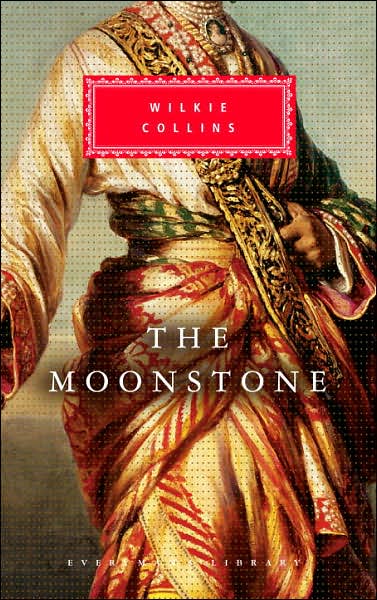
Review - The Moonstone

The Moonstone
Author: Wilkie Collins
Pages: 350+

Description:

Rachel Verinder, a young Englishwoman, inherits a large Indian diamond on her eighteenth birthday. It is a legacy from her uncle, a corrupt English army officer who served in India. The diamond is of great religious significance as well as being extremely valuable, and three Hindu priests have dedicated their lives to recovering it. The story incorporates elements of the legendary origins of the Hope Diamond (or perhaps the Orloff Diamond). Rachel's eighteenth birthday is celebrated with a large party, whose guests include her cousin Franklin Blake. She wears the Moonstone on her dress that evening for all to see, including some Indian jugglers who have called at the house. Later that night, the diamond is stolen from Rachel's bedroom, and a period of turmoil, unhappiness, misunderstandings and ill-luck ensues. Told by a series of narratives from some of the main characters, the complex plot traces the subsequent efforts to explain the theft, identify the thief, trace the stone and recover it.

My thoughts:

First order of business, I'd like to give myself a pat on the back for finishing this book. I truly dreaded almost every moment of it.

The book is filled with social satire and witty commentary. Some are funny, many are not. Here, I'll let you be the judge:
A cloak (on a woman's back) is an emblem of charity -- it covers a multitude of sins (84)
Follow me carefully, and I will prove it in two words. You choose a cigar, you try it, and it disappoints you. What do you do upon that? You throw it away and try another. Now observe the application! You choosea woman, you try her, and she breaks your heart. Fool! take a lesson from your cigar-case. Throw her away, and try another! (124)
Poor thing! the bare idea of a man marrying for his own selfish and mercenary ends had never entered her head (194) 
Have you had enough? because there's a ton more I can share, thanks to the narratives of Betterredge.
 
Also, I was only mildly curious to learn why Rachel was acting so cruel to Franklin Blake...and in my opinion the only interesting character is Mr. Candy's assistant, Ezra Jennings. He's the unsung hero, the unlikely hero. Consequently, his narrative/involvment in the plot (the opium experiment) was the only part I enjoyed. However, this doesn't happen until the last maybe 50 or so pages. I think that's the major problem with this one: it's too slow and too tedious.

I know it's a classic, but I didn't care for it. And I'm a little confused because I really liked The Woman in White. I guess I'm in the minority of people who prefer The Woman in White over The Moonstone. It is for me the better of the two. But this is just my humble opinion. That is all.

The Moonstone

Two stars.


Smooth Criminals, Reading Challenge for 2012